
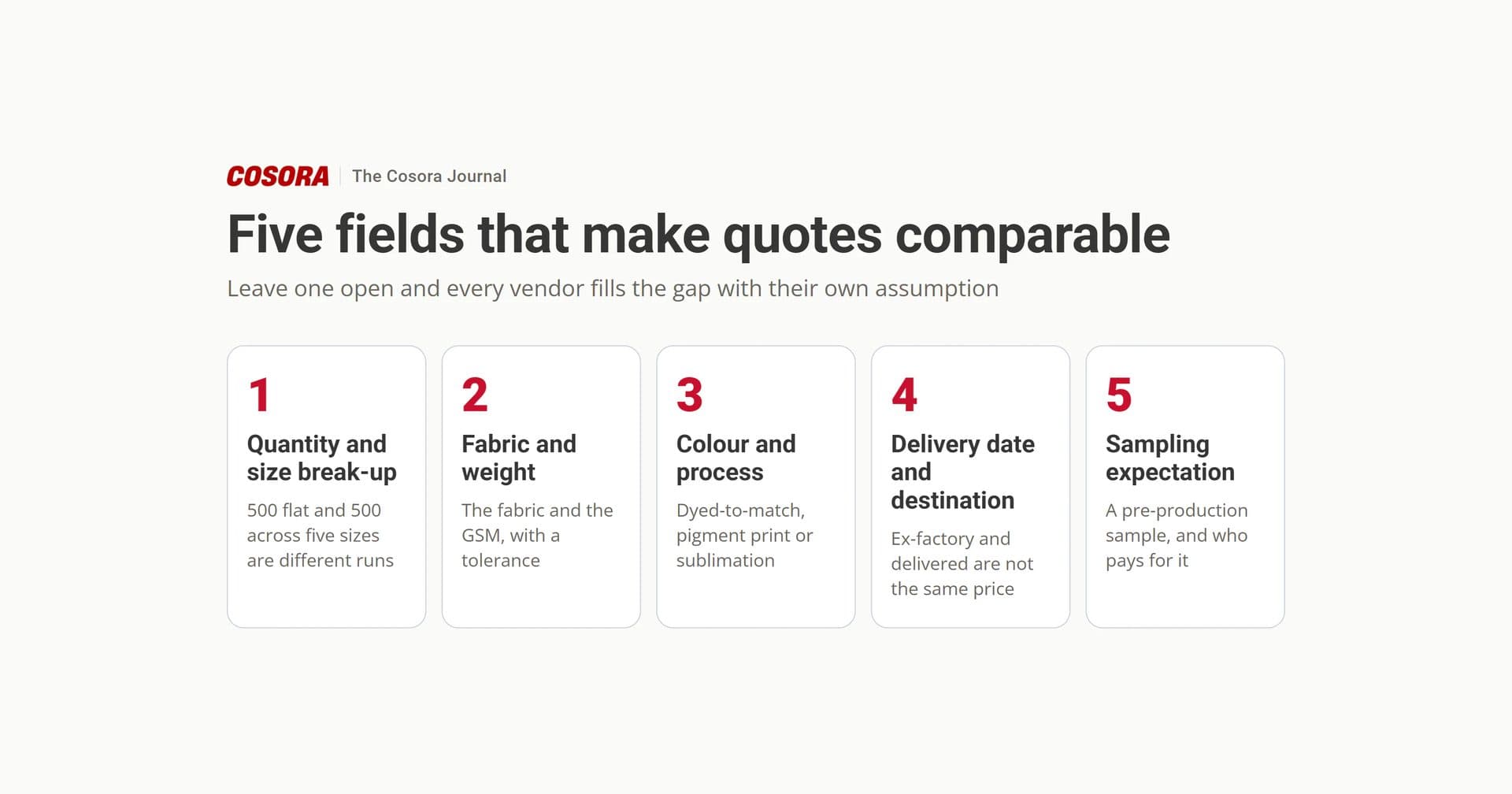
How to Write an RFQ That Gets Comparable Quotes
Most RFQs come back with quotes that cannot be compared side by side. Five fields fix that.
The Cosora Journal
Practical guides for the people who actually place and fill orders: how fabric is specified, how a requirement becomes a comparable quote, and what to check before a production run.
Sourcing in India's fashion trade still runs on knowledge that is rarely written down. Which GSM suits a summer tee versus a winter hoodie. What a mill means by "counts" and what a converter means by it. Why one quote lands at half the price of another and what has quietly been left out of it. Most of this gets learned the expensive way, one bad order at a time, and it never leaves the head of the person who learned it.
Community is where we write it down. These are working notes rather than think pieces: fabric weight ranges you can specify with confidence, the fields an RFQ needs before a manufacturer can price it accurately, how minimum order quantities are really set, what lead times assume about dyeing and finishing, and where the gaps between a sample and a bulk run usually open up.
The articles are written for both sides of the trade, because the misunderstandings run both ways. A buyer who does not know how a mill schedules production will read a lead time as a delay. A manufacturer who has never seen a badly written brief will read it as indecision. Both are usually just missing the same piece of context.
Nothing here requires a Cosora account, and nothing here is a product tour. If it helps you specify an order more precisely, it belongs in this section.
Featured story
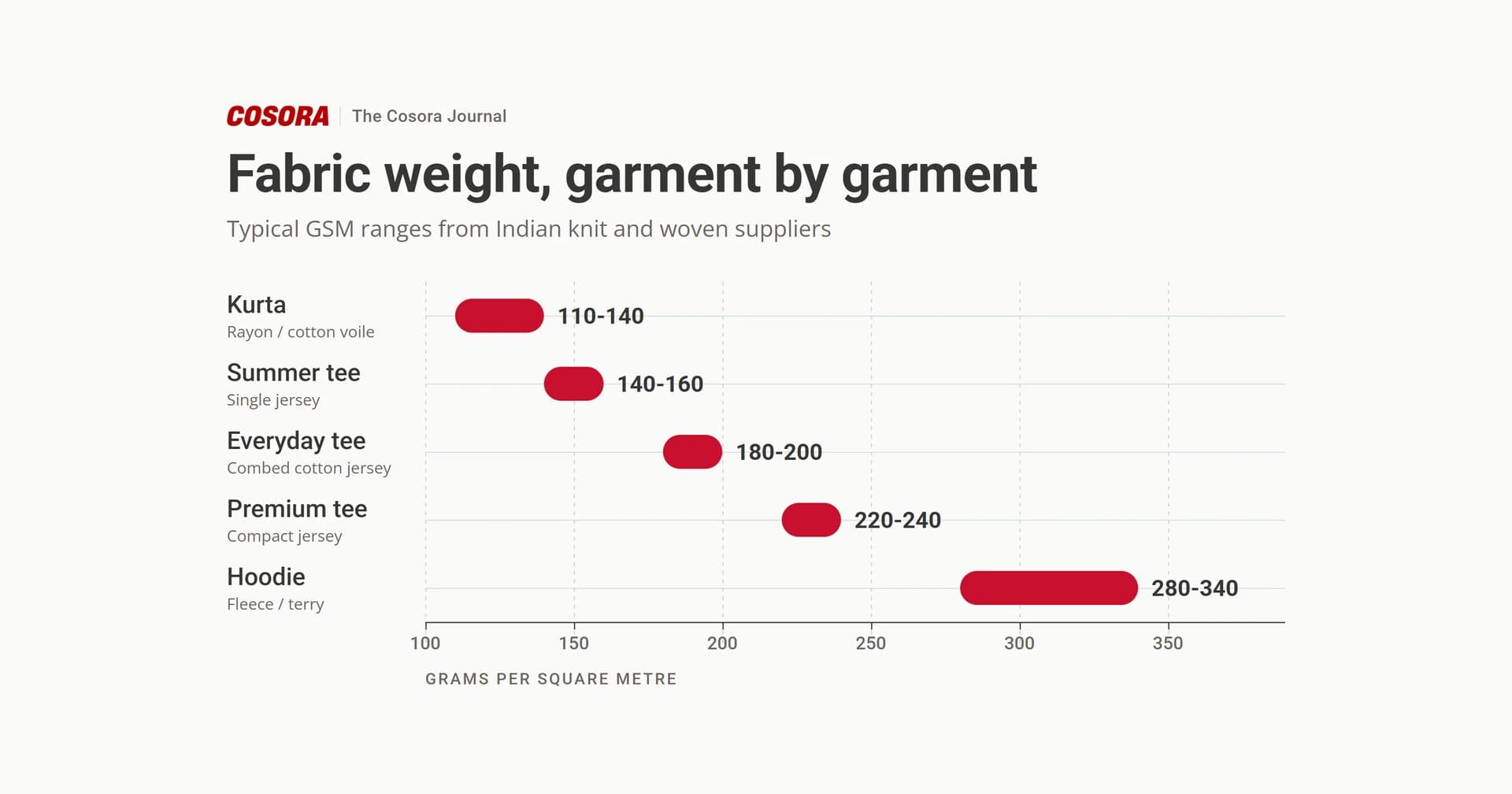
GSM is the one fabric number every RFQ should include. Here is what it measures, the ranges vendors expect for common garments, and how it changes your quote.
Read the story2 stories
Post a Quick RFQ with an image and a quantity. Verified manufacturers send you quotes to compare.
Post RFQ